Edmonton’s water has a personality of its own. Beneath the surface of every faucet lies water packed with minerals that interact with your pipes, appliances, and even your morning coffee. Over time, these minerals cause hardness in your water, changing the way water behaves in your home.
Hard water is not just an inconvenience. It can leave spots on your dishes that are difficult to remove even with good detergents. It can also leave your skin dry after a shower due to calcium and magnesium present in water. Most of all, it can make appliances like water heaters inefficient, as mineral buildup creates insulating layers, forcing them to work harder.
The tried-and-tested solution to all these problems is a water softener. And in this guide, we’ll break down everything you need to know about them, such as the types of water softeners, the factors that really matter, and the best water softeners in Edmonton. So, let’s dive right in!

Why Hard Water Is Common in Edmonton Homes
It’s simple: because of Edmonton’s geography. Most of the city’s water comes from the North Saskatchewan River, which winds through the region picking up minerals from limestone and chalk deposits along the way.
These minerals remain in the water even after it’s treated and delivered to homes. While they aren’t harmful to health, they are what make water “hard,” and they cause buildup in pipes, appliances, and plumbing, causing gradual damage.
Water hardness is measured in milligrams per litre (mg/L) of calcium carbonate or in grains per gallon (gpg). Here’s a guide to understand the ranges:
| Hardness Level | mg/L (ppm) | gpg | Description |
| Soft | 0–60 | 0–3.5 | Rarely causes issues |
| Moderately hard | 61–120 | 3.5–7 | Occasional buildup |
| Hard | 121–180 | 7–10 | Noticeable scale |
| Very hard | 181+ | 10+ | Frequent buildup & issues |
Based on testing and municipal reports, Edmonton’s water generally falls in the hard to very hard range, making it essential to install a water softener.

Best Water Softeners for Edmonton in 2026 (Based on Category)
Let’s break down the three main categories so you can see which fits your home best.
1. Salt-Based Ion Exchange Systems
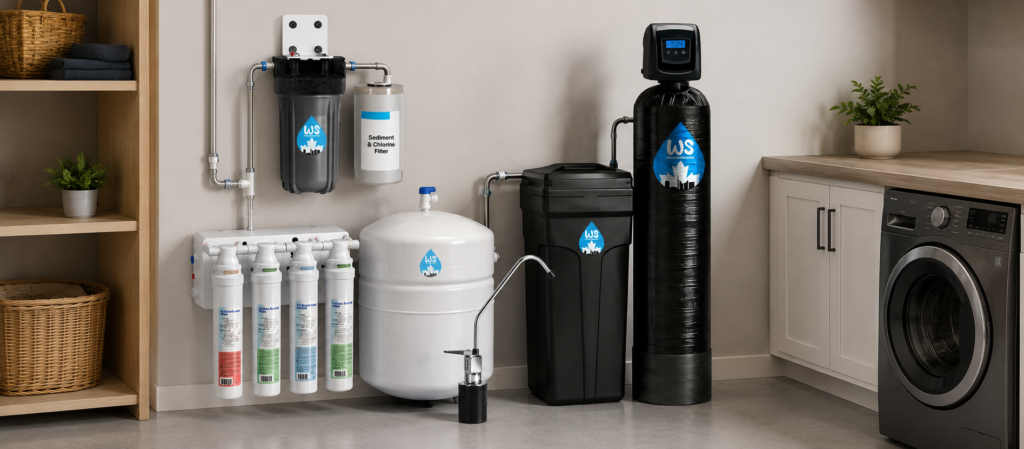
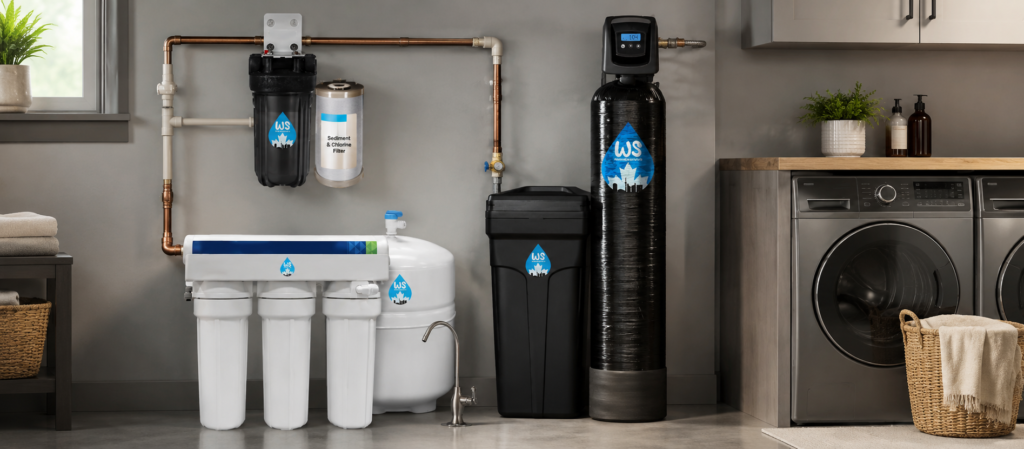
These are the classic water softeners you’ve probably seen in commercials, and for a good reason: they work. A salt-based ion exchange system swaps the hardness minerals in your water (calcium and magnesium) for sodium or potassium ions. The latter are responsible for softening your water, making it fresh and smooth for everyday use.
Who should get this: Families dealing with very hard water, homes with older pipes, or anyone who wants soft water everywhere, from showers to dishwashers.
Pros:
- Effectively removes most hardness minerals, giving you silky showers, easier laundry, and no scale on appliances.
- Can handle high water usage, so it’s ideal for large households.
- Long-lasting results when properly maintained.
What it can do for you: Your morning shower will feel smoother on skin and hair, kettles and faucets will stay cleaner for longer, and appliances will run more efficiently.
If you’re looking for a premium quality water softener and a filtration system for your home, read here for some recommendations.
2. Salt-Free Water Conditioners
Salt-free systems don’t remove the minerals from water, but change the way the minerals behave so they’re less likely to stick and form scale. They use a process called template-assisted crystallization (TAC), which keeps the minerals suspended and non-damaging.
Who should get this: Smaller households, environmentally conscious homeowners, or those looking for a low-maintenance solution who don’t have extremely hard water.
Pros:
- No salt to refill, less maintenance.
- Eco-friendly and better for your lawn or garden if you’re worried about runoff.
- Reduces scale buildup in pipes and appliances over time.
What it can do for you: You won’t feel the slippery “soft water” sensation as much as with salt-based systems, but you’ll notice fewer scale spots, easier cleaning, and appliances that last longer. Perfect if you want a maintenance-free approach.
3. Dual-Tank / Demand-Initiated Regeneration (DIR) Systems
Dual-tank systems are essentially the heavy-duty, luxury option. They have two resin tanks so one is always ready while the other regenerates automatically. A demand-initiated system only regenerates when needed, saving water and salt.
Who should get this: Large households, homes with inconsistent water use, or anyone who wants uninterrupted soft water 24/7.
Pros:
- Continuous soft water even during regeneration.
- More efficient salt and water usage compared to single-tank systems.
- Ideal for high-demand households without downtime.
What it can do for you: Imagine never having to plan around regeneration cycles or worry about running out of soft water during peak usage. Unlike manual systems, you won’t have to check salt levels constantly or schedule downtime, as the softener will handle that on its own.
Also read: Edmonton Dishwashers and Washers Love Soft Water, Here’s why
Buyer’s Decision Guide: Choosing the Right Water Softener
| Recommended Category | Water Supply Type | Household Size | Approx. Hardness Levels |
| Salt-Based Ion Exchange System | City water or well water | Small to medium households (2–4 people) | Hard to very hard (120–200+ mg/L) |
| Dual-Tank Ion Exchange System | City water or well water | Large households (4–6+ people) | Hard to very hard (150–200+ mg/L) |
| Salt-Free Water Conditioner | City water | Small households (1–3 people) | Moderately hard to hard (60–150 mg/L) |
The table above gives a quick overview, but let’s break down how exactly you can make an informed choice while purchasing a water softener:
1. Start with a water hardness test
Before choosing a system, you can get a professional water test done in order to know exactly how hard your water is. Edmonton homes typically fall in the hard to very hard range, but testing your water gives you a precise number to work with. Once you know the hardness level, you can estimate how much mineral removal your system needs to handle.
2. Estimate your daily water usage
A common rule of thumb is that the average person uses 75–100 gallons of water per day in a home. You can estimate your household’s daily demand with a simple formula:
Household water usage = Number of people × 75 gallons (approx.)
For example:
- 3 people × 75 gallons ≈ 225 gallons per day
- 5 people × 75 gallons ≈ 375 gallons per day
This gives you a rough idea of how much water your softener will need to treat each day.
3. Estimate the softener capacity you need
Water softener capacity is usually measured in grains removed per day. You can estimate the requirement with another simple formula:
Required capacity = Daily water usage × hardness level (in gpg)
For instance, if your household uses 300 gallons per day and your hardness level is 10 gpg, your system needs to handle roughly:
300 × 10 = 3,000 grains per day
From there, you can choose a system that comfortably exceeds that capacity so it doesn’t regenerate too frequently.
4. Match the system type to your situation
Once you understand your hardness level and daily usage, the category becomes easier to decide:
- Hard to very hard water (most Edmonton homes): A salt-based ion exchange softener is usually the most reliable option.
- Large households with heavy water use: A dual-tank system ensures continuous soft water even during regeneration cycles. So even if you have multiple people in your house using water heavily on a daily basis, it will still remain soft.
- Smaller homes with moderate hardness levels: A salt-free conditioner can help reduce scale buildup with minimal maintenance. Best if you just want to make water slightly more manageable for your daily routine without having to look after the system too much.
Common Mistakes People Make When Choosing a Water Softener
Buying a water softener isn’t something most homeowners do often, so it’s easy to overlook a few important details during the process. Here are some common mistakes to avoid:
Choosing the Wrong Size
Oftentimes, people end up choosing a system that’s too small for the household. An undersized softener regenerates too often, using more salt and water than necessary, while still struggling to keep up with demand.
Likewise, an oversized system can also be inefficient and unnecessarily expensive. Matching the system capacity to your household size and hardness level makes a big difference in performance.
Buying the Most Expensive System
It’s easy to assume that the most advanced or expensive model is automatically the best option. In reality, many households simply don’t need high-capacity or dual-tank systems.
For example, a small family with moderate water usage might be perfectly served by a standard salt-based softener.
Ignoring the Hardness Levels
Some homeowners purchase a water softener without testing their water first. Hardness levels can vary even within the same city, and the system you choose should be based on those numbers. Without this information, you may end up with a system that doesn’t fully address the problem.
Overlooking maintenance requirements
Every system requires some level of upkeep. Salt-based softeners need periodic salt refills, while other systems may require filter replacements or inspections.
Not factoring this into your decision can lead to frustration later.
Not considering future water usage
Household needs change over time. A system that works well for a couple may struggle if the household grows or water usage increases. Choosing a system with a little extra capacity can help avoid upgrading too soon.
Looking for Reliable Water Softeners? Reach Out To Us!
Edmonton’s water will always carry minerals from the North Saskatchewan River, and that’s simply part of living in the region. The real difference comes from how you deal with it. The right water softener can take the pressure off your plumbing, help appliances run more efficiently, and make everyday water use feel a lot less frustrating.
At Water Softener Edmonton, we help homeowners find solutions that match their household size and usage. Explore our range of water softeners or reach out to us to find the system that will work best for your home.