Moving into a new build comes with a long list of decisions. Things like flooring, lighting, and layouts usually get all the attention, while water quality often gets neglected. But in a city like Edmonton, where hard water is part of the equation across most neighborhoods, it’s something worth thinking through before everything is finalized.
The advantage with a new build is timing, as you’re in the best position to set things up properly from day one. Planning for a water softener in a new build early means cleaner installation, better placement, and a system that fits your home instead of being squeezed into it later.
It’s one of those decisions that doesn’t feel urgent now, but makes a huge difference once you’re actually living in the space. Let’s discuss some of the best new build water softener categories in Edmonton, so you know what to include in the construction process while planning your home’s plumbing and layout from the start.
Why It’s Better to Plan Water Softening During Construction
When your home is still under construction, a lot of things are easier simply because nothing is locked in yet. Plumbing is accessible, walls aren’t closed, and the mechanical space hasn’t been fully occupied. That gives you room to make smarter decisions about where and how a water softener should be installed, instead of working around limitations later.
You’re working with open access, not finished spaces
At this stage, connecting to the main water line is straightforward. There’s no need to cut into drywall, shift existing pipes, or work around finished flooring. What would normally take extra effort later can be done cleanly while everything is still exposed.
Placement actually makes sense when it’s planned early
A softener needs a proper spot with access to drainage and enough space around it. When it’s planned ahead, it can sit where it’s easy to reach and maintain, instead of being squeezed in wherever there’s leftover room.
The install ends up cleaner (and less patched together)
Retrofit installs often involve small compromises as you have to deal with extra piping, longer drain runs, or less-than-ideal positioning. When it’s part of the build plan, everything connects more directly, and the system feels like it belongs there.
It usually costs less to do it now
Labor tends to be simpler during construction because everything is accessible. There’s less time spent navigating finished areas or making adjustments, which often keeps installation costs lower compared to adding it afterward.
You don’t have to second-guess your setup later
A lot of homeowners end up revisiting this decision within the first year, especially after noticing buildup on fixtures or changes in water feel. Planning ahead removes that back-and-forth and lets you move in with everything already sorted.
Also read: Complying with Edmonton Plumbing Codes for Water Softeners
Best Water Softening Systems For New Builds in Edmonton
| Setup Type | Best For | Space Needed | Maintenance |
| Full Home Water Softener | Most households | Moderate (basement/mechanical room) | Regular salt refills |
| Softener + Filtration Combo | Families focused on overall water quality | Slightly more space | Filters + salt upkeep |
| Compact / High-Efficiency Units | Smaller homes or tight layouts | Low | Lower salt/water usage |
| Salt-Free Systems (Conditioners) | Low-maintenance preference | Low to moderate | Minimal |
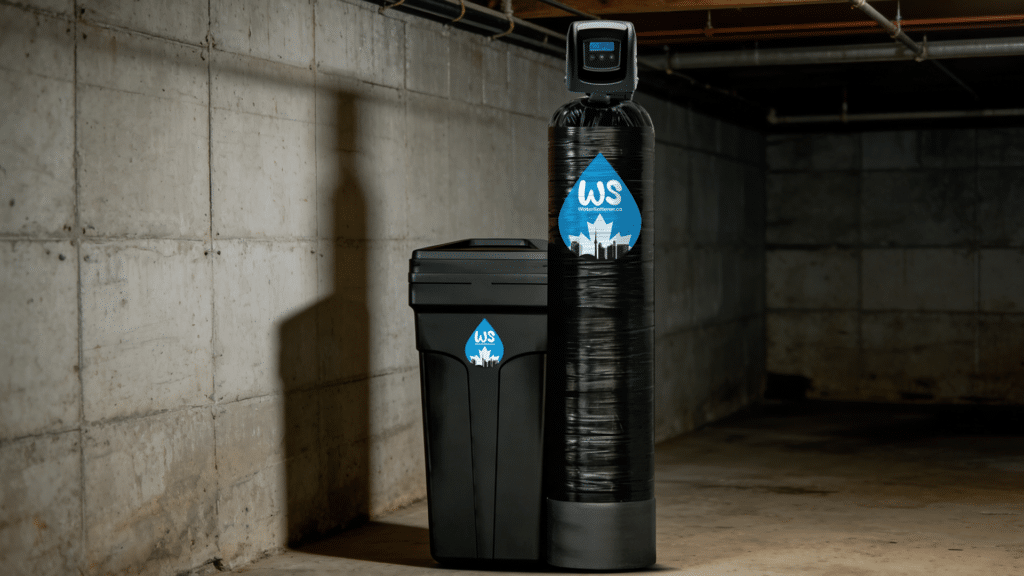
Full Home Water Softener Systems
This is the standard setup for a reason, as it actually removes hardness minerals (calcium and magnesium) using ion exchange. Installed at the main water line, it treats everything coming into the house.
Key features to look for:
- Grain capacity: typically 32,000–64,000 grains for most homes
- Flow rate: should match multi-bath usage (especially in 3+ bathroom homes)
- Metered regeneration: system regenerates based on usage, not a timer
Why it works well in new builds:
- Full coverage from day one (showers, laundry, appliances)
- Prevents scale buildup in pipes and water heaters early
- Fits easily into basement/mechanical room layouts
Trade-offs:
- Requires ongoing salt refills
- Needs proper drain and space clearance
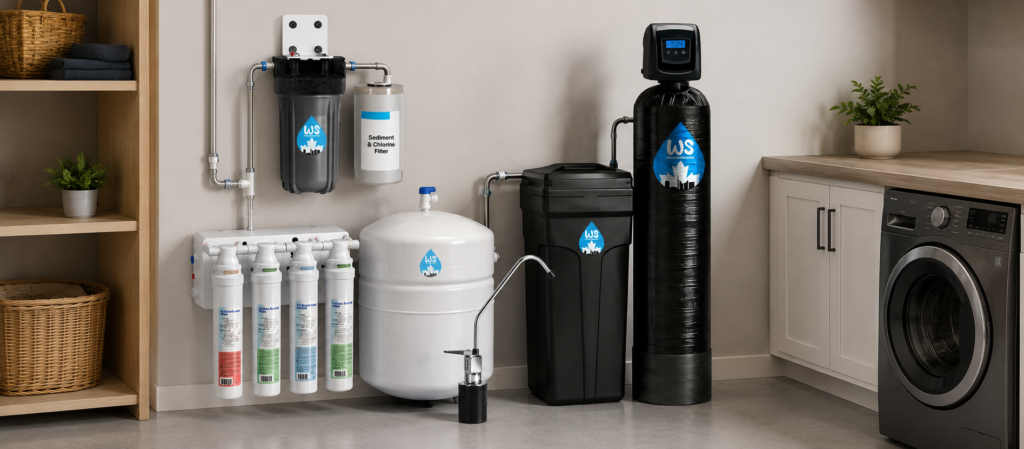
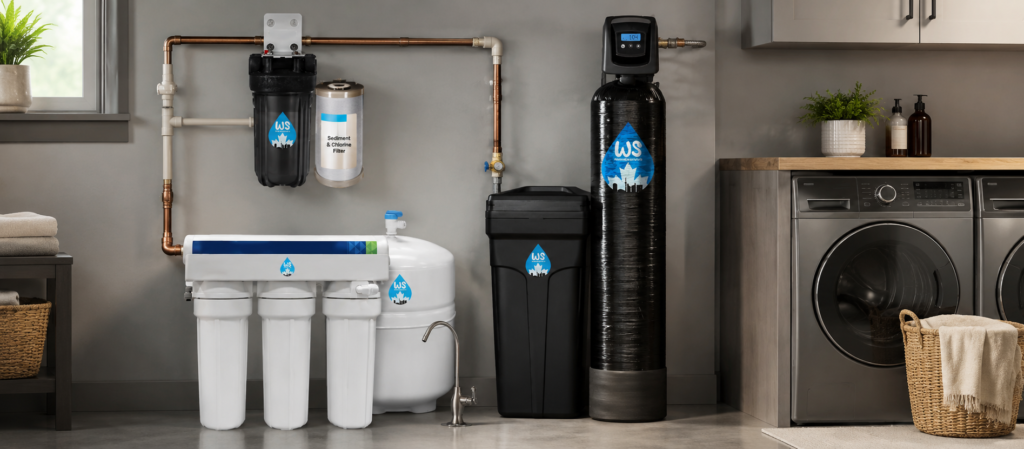
Softener + Whole Home Filtration Combo
This setup pairs a standard softener with a carbon filtration system (often installed before the softener). It handles both hardness and common city water additives like chlorine.
What you’re adding beyond softening:
- Carbon filtration tank: reduces chlorine taste and odor
- Better water quality overall, not just softer feel
- Often improves water for drinking and bathing
Best use cases:
- Families sensitive to chlorine smell/taste
- Homes where water quality (not just hardness) is a priority
- Long-term “set it and forget it” setups
Trade-offs:
- Takes more physical space (two tanks instead of one)
- Filter media needs replacement every few years
Compact or High-Efficiency Units
These are designed for tighter layouts or homeowners who want lower operating costs. They still use ion exchange but are built to be more efficient in how they regenerate.
Key features:
- High-efficiency resin: uses less salt per cycle
- Demand-based regeneration: only runs when needed
- Smaller footprint: ideal for limited mechanical space
Where they make sense:
- Townhomes or smaller detached homes
- Mechanical rooms with limited clearance
- Households looking to reduce salt and water usage
Limitations to watch:
- Lower grain capacity. It would need proper sizing
- May struggle if undersized for large families or high usage
Salt-Free Systems (Conditioners)
These systems don’t remove hardness minerals. Instead, they alter how minerals behave so they’re less likely to stick to surfaces.
What they actually do:
- Reduce scale buildup on fixtures and pipes
- Require no salt, no regeneration cycle
Where they can work:
- Homes with moderate hardness levels
- Owners who want minimal maintenance
- As a supplement to filtration systems
Important limitations (especially for Edmonton):
- Water will still feel “hard” (no change in soap lathering)
- Doesn’t protect appliances as effectively as true softening
- Less reliable in areas with higher hardness levels
Also read: Water Softener Installation Cost in Edmonton: Full Breakdown
Where Should a Water Softener Be Installed in a New Build?
In a new build, the best place for a water softener is usually close to the main water line, in a mechanical room, utility area, or basement space where it can connect properly and still be easy to access.
Here are the main placement details to plan for:
1. Close to the Main Water Entry Point
The softener should be installed near the point where water first enters the home. This allows the system to treat water before it travels to showers, faucets, laundry, the dishwasher, and the water heater.
2. In a Mechanical Room or Utility Space
For most Edmonton new builds, the mechanical room is the most practical location. It already holds equipment like the furnace, water heater, HRV, and plumbing connections, so adding a softener there keeps the setup organized.
This also makes future service easier. A technician can access the system without moving furniture, opening finished walls, or working in a living area.
3. Near a Proper Drain
A traditional salt-based water softener needs a drain for its regeneration cycle. That is when the system flushes out hardness minerals and refreshes the resin inside the tank.
A nearby floor drain or proper standpipe makes the installation cleaner. If the drain is too far away, the installer may need a longer drain line, which can look messy and may not be ideal for long-term performance.
4. With Enough Room for Salt and Service
A softener may fit into a tight corner, but that does not mean it should go there. You need enough space to open the brine tank, add salt, check controls, and allow service access around the unit.
For planning purposes, it helps to leave open space in front of and above the system. This is especially important if the mechanical room will later be used for storage.
5. Away From Areas You May Finish Later
If you plan to finish the basement, build storage rooms, or add walls later, the softener should not be placed where it will become boxed in. It should remain accessible even after future upgrades.
This is one of the biggest advantages of planning during construction. You can choose a location that works now and still makes sense after the home is fully lived in.
Key Features to Look for in a New Build Water Softener
Grain Capacity: This tells you how much hard water the system can handle before it regenerates. For example, a 3–4 person home in Edmonton would usually fall in the 40,000–48,000 grain range. You’ll see this listed clearly on product pages or spec sheets when you’re comparing systems.
Flow Rate: This shows how well the system keeps up when multiple fixtures are running. If your home has 2–3 bathrooms, you want a system that won’t drop pressure during peak use. Flow rate is usually mentioned in GPM (gallons per minute) on the product specs.
Regeneration Type: Most modern systems use metered regeneration, which means they only regenerate based on water usage. This is highlighted as a feature on the product listing or described as “on-demand” or “demand-initiated” regeneration.
Salt and Water Efficiency: Some systems are designed to use less salt and water per cycle. This is often mentioned in product descriptions as “high-efficiency” or shown in comparison charts on supplier websites.
System Size: This refers to the physical size of the unit, not just capacity. Product pages usually include dimensions (height, width, depth), so you can match it to your available mechanical room space before buying.
Control Valve Quality: The control valve is the main working component of the system. Higher-quality systems will mention the valve brand or type in their specs, and this is something installers or suppliers can also guide you on if it’s not clearly listed.
These details are usually easy to find once you know what to look for—they’re either listed directly on the product page or available in the spec sheet provided by the supplier.
Setting Up a Water Softener For Your New Build In Edmonton?
A water softener is much easier to plan before your new home is finished. You can choose the right location, leave enough room for service, and make sure the system is sized properly for your household from the start.
If you are building a home in Edmonton and want help choosing the right setup, we can help. At Water Softener Edmonton, we look at your home size, plumbing plan, water use, and available space so you can choose a system that fits the way your home will actually be used.
Get in touch with us and we’ll help you plan the right water softener setup before construction is complete.